Why Your Bank Still Faxes Documents in 2026
I toured a trade operations floor in London last month. The bank spends north of $200 million a year on technology. Its retail division has biometric authentication and AI-powered fraud detection. Its trading desk runs models that price derivatives in microseconds.
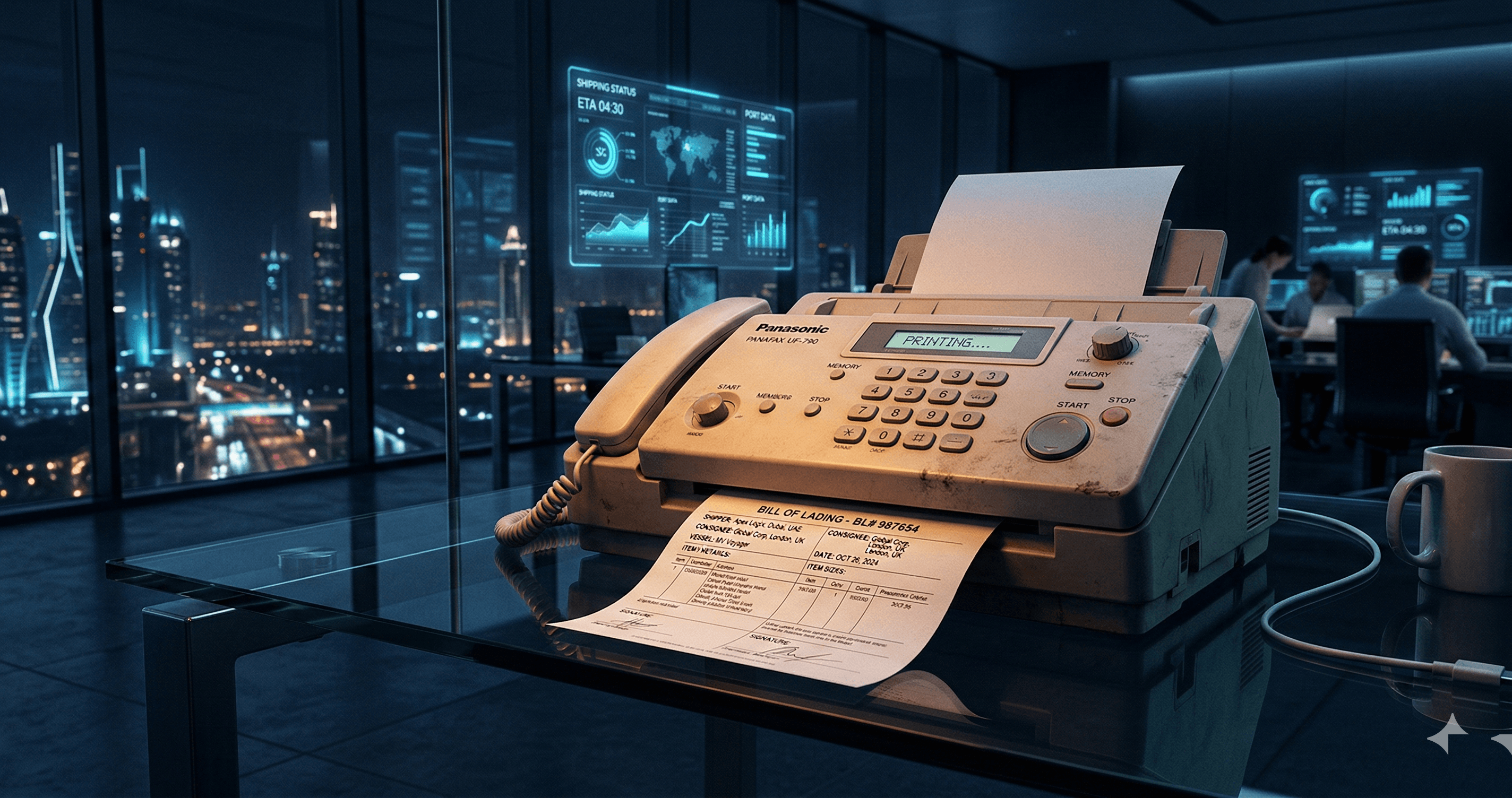
In the back corner of the trade finance department, next to a filing cabinet, a multifunction printer was receiving a fax. A bill of lading, arriving by telephone line, in 2026.
The ops manager did not find this remarkable. "We get maybe 30% of our documents by fax or courier," he said. "Down from 50% five years ago. The rest come by email as PDF scans. Almost nothing comes electronically in a way our systems can actually process without re-keying."
The ICC's 2024 Global Survey on Trade Finance found that over half of trade finance transactions still involve at least one paper document transmitted by physical courier or fax. The Boston Consulting Group estimated in a 2023 report for the ICC that the global trade finance document handling process costs the industry $5 billion annually. Those numbers have barely moved in a decade.
Why the fax survives
The technology to replace paper has existed for years. The blockers are structural, not technical, and they reinforce each other.
Centuries of law built on paper. A bill of lading is a document of title. The person or entity that holds the physical original controls the goods. That principle runs through maritime law, commercial codes, and banking practice across virtually every jurisdiction. Replacing it with a digital equivalent requires legislative change in each country, one at a time.
MLETR, the UN framework for making electronic trade documents legally equivalent to paper, has been adopted by roughly a dozen jurisdictions. Eleven out of 195 countries. Singapore's February 2026 implementation is the most commercially significant to date, because Singapore is a major shipping hub. The UK's 2023 Electronic Trade Documents Act was symbolically important but operationally limited by the UK's small share of physical cargo flows. China, India, Brazil, and most of Africa have not moved.
A trade finance lawyer in Singapore said: "The law in any single jurisdiction is a necessary condition, not a sufficient one. A shipment from Vietnam to Kenya via Singapore needs legal recognition in all three places. We have it in one."
Liability that nobody has tested. When a paper bill of lading is forged, the liability chain is established by case law going back to the 1800s. When an electronic bill of lading on a platform is compromised or disputed, the liability questions are open. Who bears the loss? The platform operator? The issuing carrier? The bank that relied on the electronic document? A maritime trade lawyer in London noted that as of early 2026, not a single eBL-related dispute had been adjudicated in an English court. "We are asking banks to trust a system that has no case law. For institutions that manage risk for a living, that is a hard sell."
The weakest-link problem. A typical LC transaction involves four to six parties across two to four jurisdictions. Every party needs to accept the same document format. If one bank in the chain insists on paper (or simply lacks the platform integration), the entire chain reverts to paper.
A senior trade operations manager at a Nordic bank described the dynamic: "I can be on Bolero, essDOCS, and WAVE BL. My counterparty's bank in Bangladesh is on none of them. So I send paper. The decision is not mine."
Paper's stubborn reliability. A paper bill of lading endorsed in blank can be transferred anywhere in the world. It works in Lagos the same way it works in Rotterdam. It requires no platform, no internet connectivity, no software compatibility check. It has been doing this for over a century.
The cost of paper, typically $5 to $15 per document in handling and courier fees, is modest relative to the transaction values in trade finance. On a $10 million cargo, the entire document handling cost is noise. The urgency to digitize is about speed and operational efficiency, not per-document savings. And for banks running stable processes that work, the business case for disrupting those processes is weaker than vendors suggest.
What will actually move the needle
After twenty years of "five more years" predictions, the honest answer is that three forces have the potential to shift the balance. None involves a new platform or a new pilot programme.
Carrier mandates. Maersk, MSC, and CMA CGM collectively control over half of global container shipping capacity. When these carriers make electronic issuance the default, not just available, the coordination problem shrinks dramatically. Maersk has committed to 100% eBL capability. "Capability" is not "default." The distinction matters.
Regulatory incentives. Basel capital treatment does not currently distinguish between paper-documented and electronically-documented trade finance. If regulators offered reduced capital charges for transactions with end-to-end digital document flows, every bank's cost-benefit calculation would change overnight. The Bank for International Settlements floated this concept in a 2023 working paper. No regulator has acted on it.
Crisis. COVID-19 moved more trade finance processes to digital channels in six months than the prior decade of innovation programmes. The Red Sea shipping disruptions in 2024 forced some banks to accept scanned documents when couriers could not reach certain ports. Trade finance digitizes in response to operational emergencies, not strategic planning.
Until one of these forces reaches critical mass, the fax machine stays plugged in. Not because anyone prefers it, but because the system that produced it has been reliable for a century, and the system meant to replace it has been "almost ready" for twenty years.
-- Tamara
Enjoyed this? Get it in your inbox every week.
Sharp trade finance intelligence, delivered free. No spam, no sponsored content.