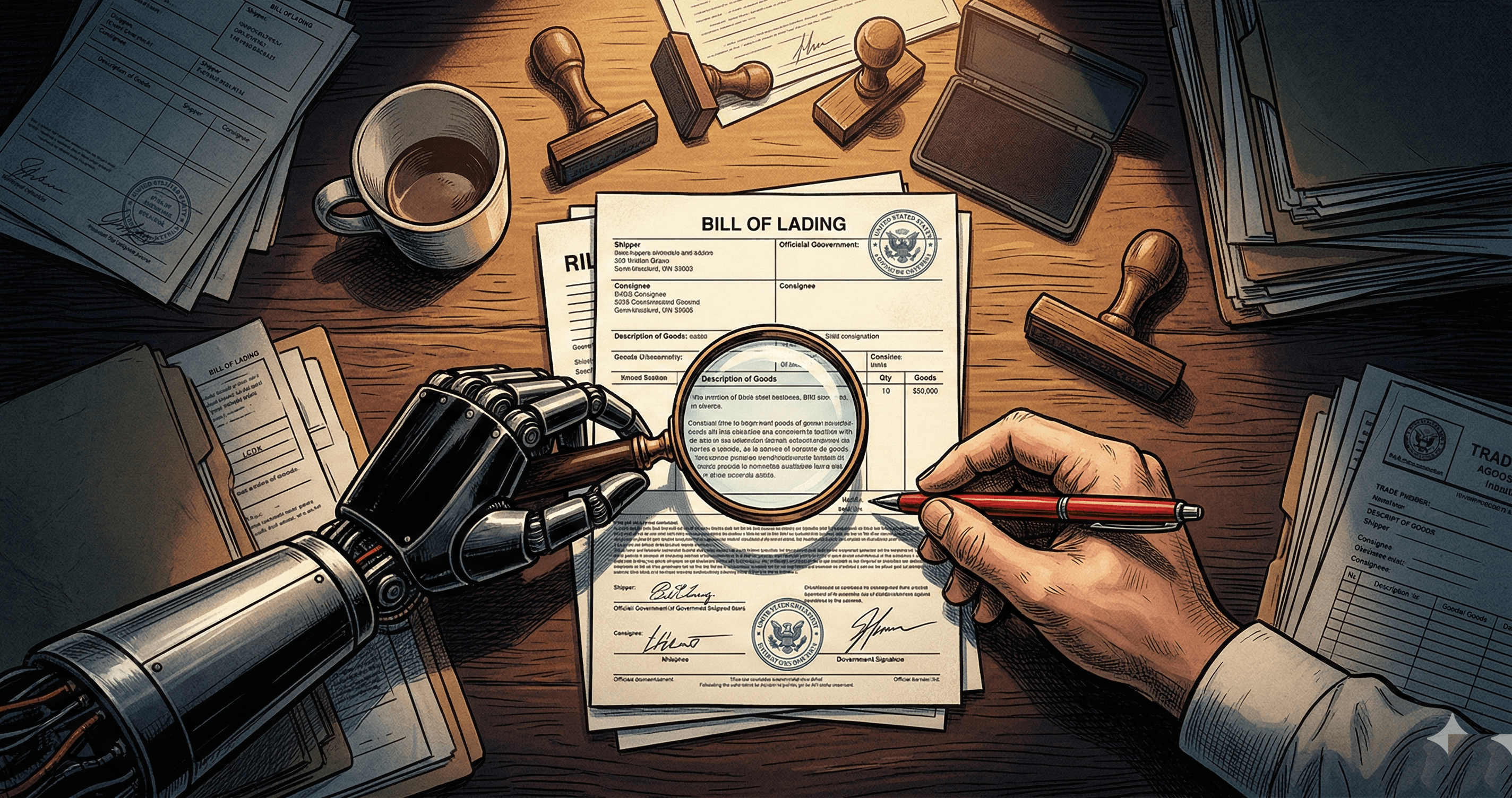
AI Won't Replace Your Trade Ops Team. Here's What It Will Do.
I spent last week talking to four banks that are piloting AI for documentary credit checking. One head of trade operations, at a European bank processing roughly 40,000 LCs annually, put it plainly: "The vendors show us demos on clean PDFs. Our documents have coffee stains, handwritten endorsements, and three languages on the same page."
That is the gap between the conference pitch and the back office.
The vendor promise vs. the production floor
The sales deck is always the same: feed your letters of credit into the system, get discrepancy reports in seconds. Traydstream, which processes documents for HSBC, and Conpend (now Pelican AI), which works with several European banks, both demonstrate impressive extraction on standardized formats. Cleareye.ai showed a live demo at Sibos 2025 that handled a 12-document presentation in under two minutes.
On clean data, the technology works. Field extraction, cross-referencing against LC terms, flagging mismatched ports or quantities. These are solved problems for well-formatted inputs.
But trade finance documents are not well-formatted inputs.
A document examiner at a Singapore bank described the reality: "We get bills of lading with thermal printing that is half-faded. Certificates of origin stamped by chambers of commerce using formats from the 1990s. Packing lists in Chinese with English annotations handwritten in the margins. The AI chokes on all of it."
The vendors know this. Their accuracy figures, typically cited as 85-95% for field extraction, are measured on curated test sets. Production accuracy on the full range of documents that hit a trade ops desk is lower. None of the four banks I spoke with would share their internal numbers, but all said the gap between demo and production was "significant."
The triage model that actually works
The banks getting value from AI are not the ones trying to automate the examiner. They are the ones using AI as a pre-screening layer.
One Gulf-based bank described a system that sorts incoming presentations into three categories: documents where the AI has high confidence in full compliance (routed for expedited senior review, cutting check time from 20 minutes to roughly 5), documents where specific potential discrepancies are flagged (the examiner starts with the flagged fields instead of reading everything from scratch), and documents where extraction confidence is low (sent directly to manual review, no AI assistance).
The bank reported that roughly a third of its volume falls into the first bucket. That alone reduced average processing time by about 15% across all presentations.
This is not the vendor pitch. Nobody writes a press release about 15% efficiency gains. But it is real, measurable, and it compounds over thousands of transactions.
Where AI still fails
Two areas remain stubbornly difficult.
The first is semantic equivalence. "P.R.C." versus "China." "Certificate of Quality" versus "Quality Certificate." "Port Klang" versus "Pelabuhan Klang." These are the judgment calls that experienced examiners resolve in seconds and that AI systems struggle with because the universe of equivalences is effectively infinite. Some vendors maintain equivalence databases that cover common cases. None cover all of them.
The second is context. A trade operations consultant who advises banks on AI implementation said: "The system can tell you that a clause appears on the bill of lading. It cannot tell you whether that clause is standard industry practice or a genuine anomaly. That is the knowledge that retired examiners took with them, and no model has it yet."
Read our Discrepancy column on the "clean on board" case for a working example. An examiner, or an AI system, that flags "per shipper's count and weight" as rendering a B/L unclean has failed at context, not at extraction.
The honest buyer's guide
If you are evaluating AI for your trade ops desk, three questions cut through the noise:
What is the production accuracy on your document types? Not the demo. Not the benchmark. Ask for accuracy on documents from your actual corridors and counterparties. If the vendor cannot test on your data, that tells you something.
What happens when it is wrong? A false positive (flagging a compliant document) wastes an examiner's time. A false negative (approving a discrepant document) exposes the bank to loss of reimbursement under UCP 600 Article 16. Ask for the false negative rate specifically. If the vendor does not track it, walk away.
What does the human workflow look like? The best implementations redesign the examiner's workflow around the AI's output. The worst ones bolt an AI layer on top of the existing process and wonder why adoption stalls. Ask to see the production interface, not the dashboard.
AI will not replace your trade ops team. The vendors who say otherwise are selling a future that does not match the present state of the technology or the complexity of the documents. What AI will do, for banks willing to implement it honestly, is make that team faster and more consistent on the 70% of work that follows established patterns.
The other 30% still requires someone who knows what "per shipper's count and weight" means.
-- Tamara
Enjoyed this? Get it in your inbox every week.
Sharp trade finance intelligence, delivered free. No spam, no sponsored content.