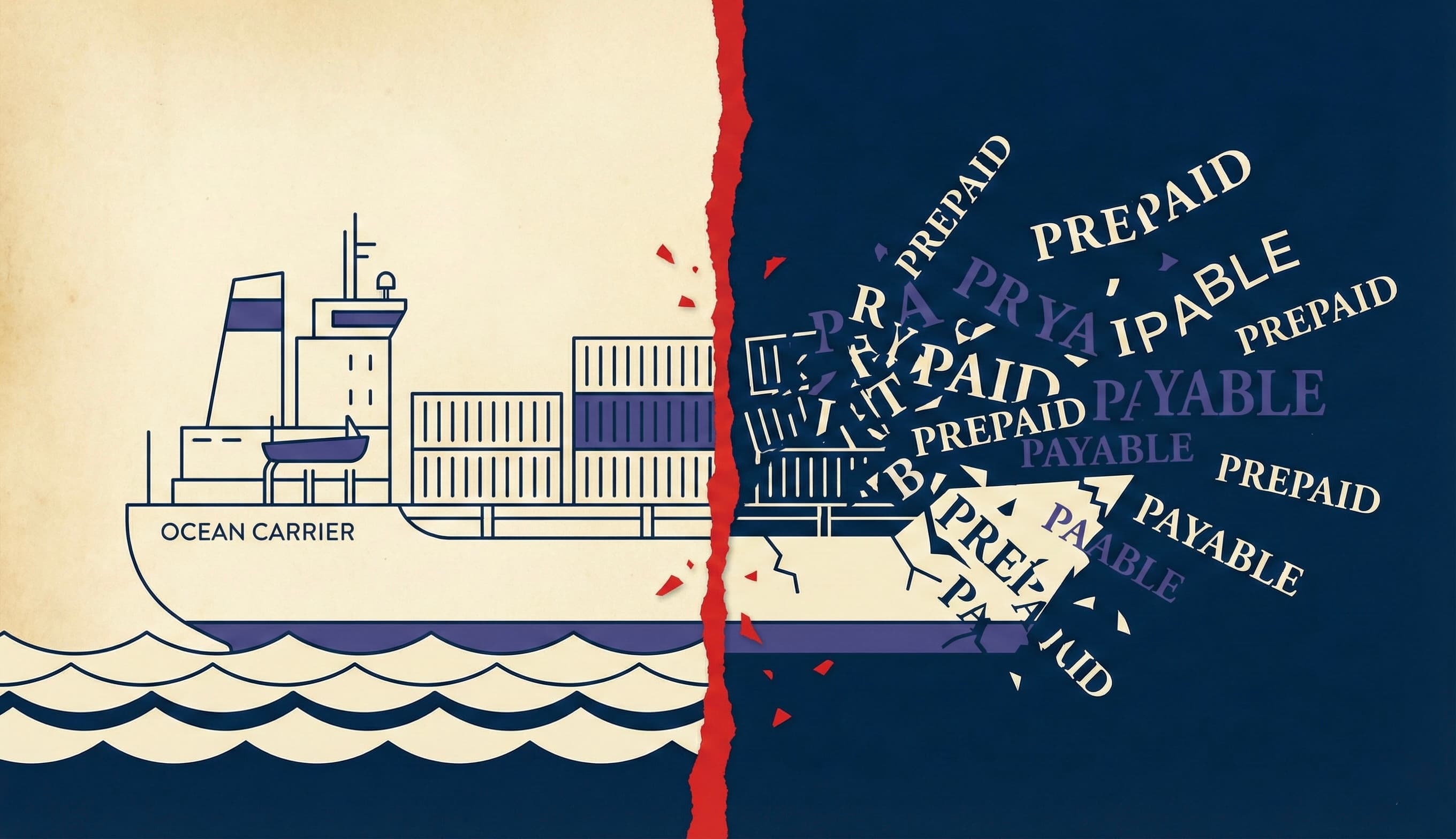
The Discrepancy #004: Freight Prepaid, Payable Where?
Six words on a bill of lading: "Freight prepaid - payable at D."
The confirming bank refused the documents. Its position: if freight has been prepaid, it cannot simultaneously be payable somewhere. Contradiction. Discrepancy raised.
The presenting bank fired back. "Payable at D" is where the carrier processed the payment, not whether payment occurred. A location, not a condition.
The ICC Banking Commission settled it in January. Opinion TA958rev. No discrepancy.
This is the third time the ICC has answered this exact question. Banks keep asking.
One says whether. The other says where.
The ICC's reasoning is elegant once you hear it.
"Freight prepaid" is a status indicator. The charges have been settled. Done. "Payable at D" is a location label. It identifies which carrier office processed the payment.
Different questions. Different answers. No conflict.
UCP 600 sub-article 14(d): data in a document need not be identical to, but must not conflict with, the credit. There was nothing on this B/L saying freight was outstanding. No "freight collect." No "due at destination." The word "payable" modified a place, not a condition.
Three rulings. Same answer.
Opinion R691 addressed identical facts years earlier. A B/L showing "Freight Prepaid" alongside "Freight payable at Bremen." The ICC's conclusion: "clearly indicates freight prepaid; no inconsistency." DOCDEX Decision 311 reached the same result.
Hamdi Missaoui, a certified trade finance professional who published a detailed analysis of TA958rev, put his finger on the gap. Shipping lines have used "payable at" to identify carrier accounting offices for decades. It is standard maritime practice. A document examiner in a bank, reading the B/L without that context, sees two freight notations side by side and reaches for the refusal.
The form is the problem
Here is why this will not stop.
Every standard ocean carrier B/L template has a pre-printed field: "Freight to be paid at." The field is on the form whether freight is prepaid or collect. When a shipper books freight prepaid, the carrier's agent marks "Freight Prepaid" in the status area and fills in the "payable at" box with the carrier's office location. Because the box is there.
The form produces the apparent contradiction by design. The carrier sees no issue. The shipper sees no issue. The presenting bank sees no issue. The examiner at the confirming bank, reading a template they have never seen filled out at a carrier's office, flags it.
"Junior examiners are trained to flag anything that looks inconsistent on the face of the document," a trade finance operations manager at a European bank told tradefinance.news. "'Prepaid' next to 'payable at' looks inconsistent if you do not know why carrier templates have both fields. The training gap is the issue."
What to do with this
Accept when: "Freight prepaid" appears on the document, no collect or unpaid language exists, and "payable at" references a location.
Refuse when: The B/L contains explicit language indicating freight remains unsettled ("freight collect," "due at destination," "unpaid"). Or when the credit specifically prohibits "payable at" notations.
Status versus location. That is the entire test.
Meanwhile, when a confirming bank raises this discrepancy, the cargo keeps moving. Demurrage clocks run. The beneficiary's working capital stays locked. The applicant gets leverage to renegotiate. All because of a pre-printed field on a carrier's template that the ICC has now rejected as a basis for refusal three separate times.
TA958rev. R691. DOCDEX 311. If your bank is still raising this, print all three.
-- Tamara
Enjoyed this? Get it in your inbox every week.
Sharp trade finance intelligence, delivered free. No spam, no sponsored content.