The Tariff Regime Reset, and Europe's Sanctions Stalemate
Two things happened last week that will reshape the operating environment for every trade finance desk in 2026.
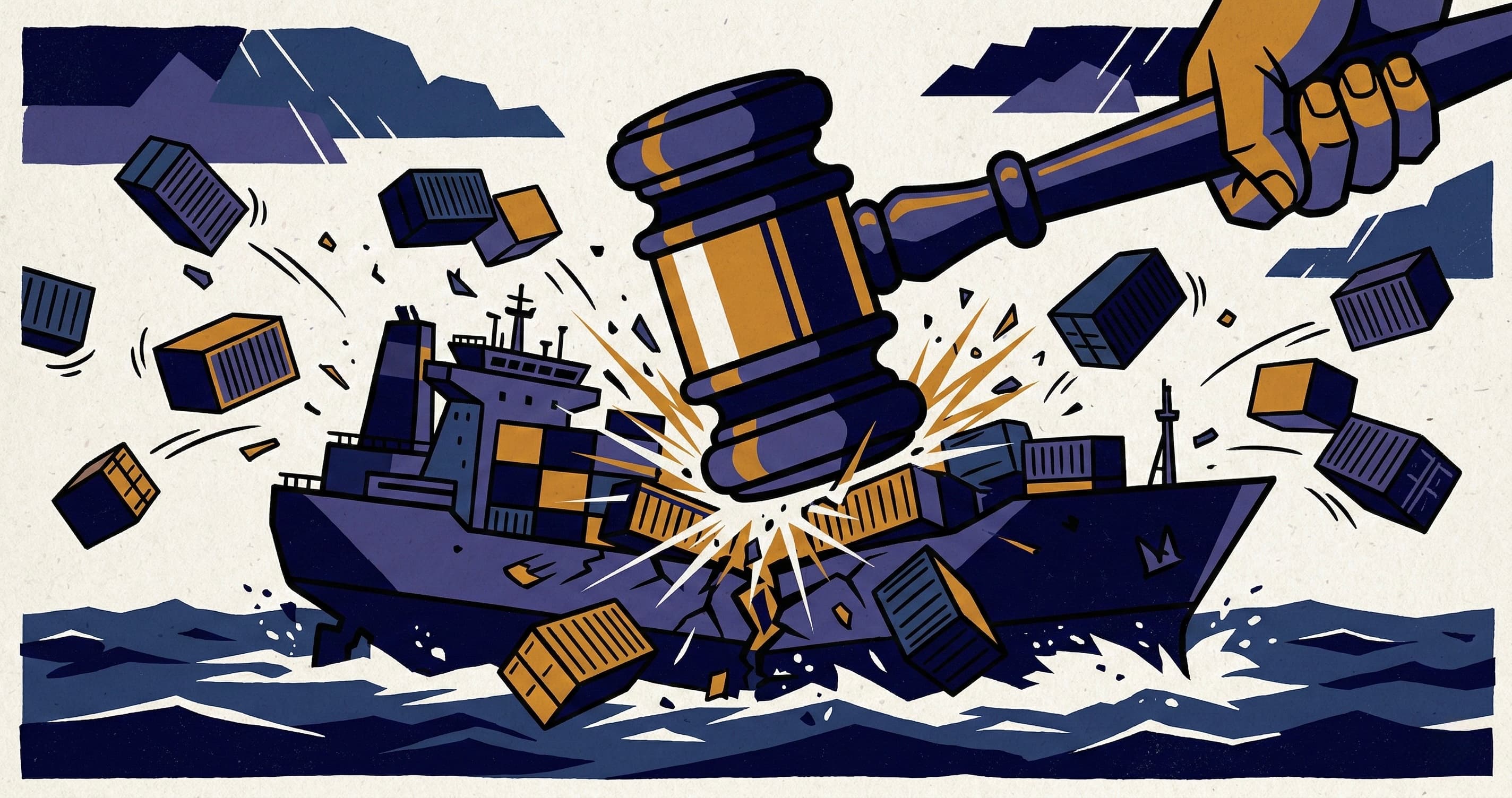
The first: the Supreme Court struck down the president's authority to impose tariffs under IEEPA. The second: the European Union failed to adopt its 20th Russia sanctions package before the fourth anniversary of the full-scale invasion of Ukraine.
Both are about the same thing: the gap between policy ambition and institutional reality.
The IEEPA ruling
On February 20, the Supreme Court ruled 6-3 in Learning Resources, Inc. v. Trump that the International Emergency Economic Powers Act does not authorize the president to impose tariffs. Chief Justice Roberts, writing for the majority, held that tariff authority is "a branch of the taxing power" reserved for Congress under Article I.
The decision struck down both the "Liberation Day" reciprocal tariffs imposed in April 2025 and the fentanyl-related tariffs on Chinese, Mexican, and Canadian goods. These tariffs had generated an estimated $175 billion in government revenue, according to the Penn Wharton Budget Model.
That money is now the subject of the largest potential customs refund in American history. Treasury Secretary Scott Bessent, asked about the possibility, was blunt: "I got a feeling the American people won't see it."
He is probably right. The Supreme Court did not address the refund mechanism. The administration will fight claims in court. Legal advisors are urging importers to file protective refund protests immediately. But the actual process for returning the money does not exist yet. This could take years.
The Section 122 pivot
Within hours of the ruling, Trump signed an executive order invoking Section 122 of the Trade Act of 1974. The provision had never before been used. Section 122 authorizes the president to impose temporary import surcharges of up to 15% to address balance-of-payments problems.
The initial proclamation set the rate at 10%, effective February 24. Trump announced the following day that he intended to raise it to the statutory maximum of 15%.
Three things make Section 122 fundamentally different from the IEEPA regime:
It has a clock. Section 122 tariffs expire after 150 days (July 24, 2026) unless Congress votes to extend them. Every trade finance facility, every pricing model, every LC that references duty costs now has a built-in expiration problem. How do you price a six-month facility when the tariff regime expires in five months?
The exemptions are broad. Energy products, critical minerals, pharmaceuticals, aerospace, passenger vehicles, and USMCA-compliant goods from Canada and Mexico are all exempt. The coverage is significantly narrower than the IEEPA tariffs it replaced.
The rate reshuffles winners and losers. A flat 10-15% surcharge, replacing country-specific IEEPA rates, paradoxically benefits some of America's strategic rivals. China's weighted tariff rate drops by an estimated 7 percentage points. Brazil drops 14 points. Meanwhile, the UK and EU see slight increases.
What this means for trade finance
For practitioners, the immediate problem is uncertainty. The IEEPA tariff regime, whatever its merits, was at least stable. Rates were known, incorporated into contracts, and priced into trade finance facilities. The new regime introduces three distinct uncertainties simultaneously:
Rate uncertainty. Is it 10% or 15%? The formal proclamation raising the rate has been ambiguous. CBP guidance has lagged the announcements.
Duration uncertainty. The 150-day clock means any trade finance commitment extending beyond July 2026 must account for the possibility that these tariffs simply disappear, or that Congress replaces them with something entirely different.
Refund uncertainty. Importers who paid IEEPA tariffs over the past year may have claims worth billions. Those claims represent a new class of receivable that could improve importers' balance sheets, or tie up capital in litigation for years. Trade credit insurers, banks with duty-financing facilities, and supply chain finance programs all need to model both scenarios.
The honest answer is that nobody knows how this resolves. The structural precedent has no modern parallel: a Supreme Court striking down an entire tariff regime while the executive immediately pivots to a different legal authority with a 150-day expiration.
Europe's sanctions stalemate
Meanwhile, the European Commission's 20th sanctions package against Russia, proposed on February 6, failed to achieve unanimous adoption before the symbolic February 24 deadline, the fourth anniversary of Russia's full-scale invasion.
The centrepiece of the package is a full maritime services ban on Russian crude oil. This would replace the existing G7 price cap mechanism, which allows EU companies to provide shipping, insurance, and port services as long as the oil trades below $60 per barrel, with a blanket prohibition regardless of price.
The package also proposes listing 43 additional shadow fleet vessels (bringing the total to 640), banning maintenance services for Russian LNG tankers and icebreakers, and activating the EU's anti-circumvention tool for the first time, targeting CNC machines and radio equipment flowing to Central Asian countries with suspiciously high re-export rates to Russia.
Greece and Malta, whose maritime industries would bear the brunt of the shipping ban, stalled negotiations through February. Their concern: the ban would push more Russian oil into the unregulated shadow fleet, benefiting Indian and Chinese operators while harming European shipowners. By late February, Malta signalled it could accept the proposal. But the package ultimately hit a different wall. Hungary vetoed the entire package over a separate dispute involving the Druzhba oil pipeline.
The shadow fleet problem
The timing is uncomfortable. While the EU debates whether to ban maritime services, the shadow fleet is already rendering the price cap irrelevant.
Russian tankers have increasingly listed Singapore as their official destination in shipping data, according to LSEG tracking, despite Singapore not importing Russian crude. The Singapore Strait and nearby Malaysian waters serve as hubs for ship-to-ship transfers that obscure the origin of cargoes.
For trade finance banks operating in Southeast Asian commodity corridors, this is a direct compliance risk. A bill of lading listing Singapore as the discharge port may not reflect where the cargo actually ends up. Standard document-based sanctions screening, checking the stated destination against restricted lists, is insufficient when the documentation itself is unreliable.
The EU's proposed maritime ban, if eventually adopted, would force a cleaner separation between EU-regulated and unregulated oil trade. But as Lloyd's List has noted, the more likely near-term effect is to complete Russia's transition into shadow fleet operations, making the trade flows harder to track, not easier.
What to watch
On tariffs: the 150-day clock is the critical variable. Watch for Congressional action, or inaction. If Section 122 tariffs expire in July with no replacement, importers face another discontinuity. If Congress passes legislation to extend or replace them, that legislation will take months to negotiate.
On sanctions: watch Hungary. The Druzhba pipeline dispute is the blocking issue, not Greece or Malta's shipping concerns. If Brussels offers Budapest a side deal on pipeline flows, the 20th package could move quickly. Without it, the stalemate continues.
In both cases, the message for trade finance practitioners is the same: build optionality into your facilities and your pricing. The policy environment is not settling down. It is speeding up.
Enjoyed this? Get it in your inbox every week.
Sharp trade finance intelligence, delivered free. No spam, no sponsored content.